
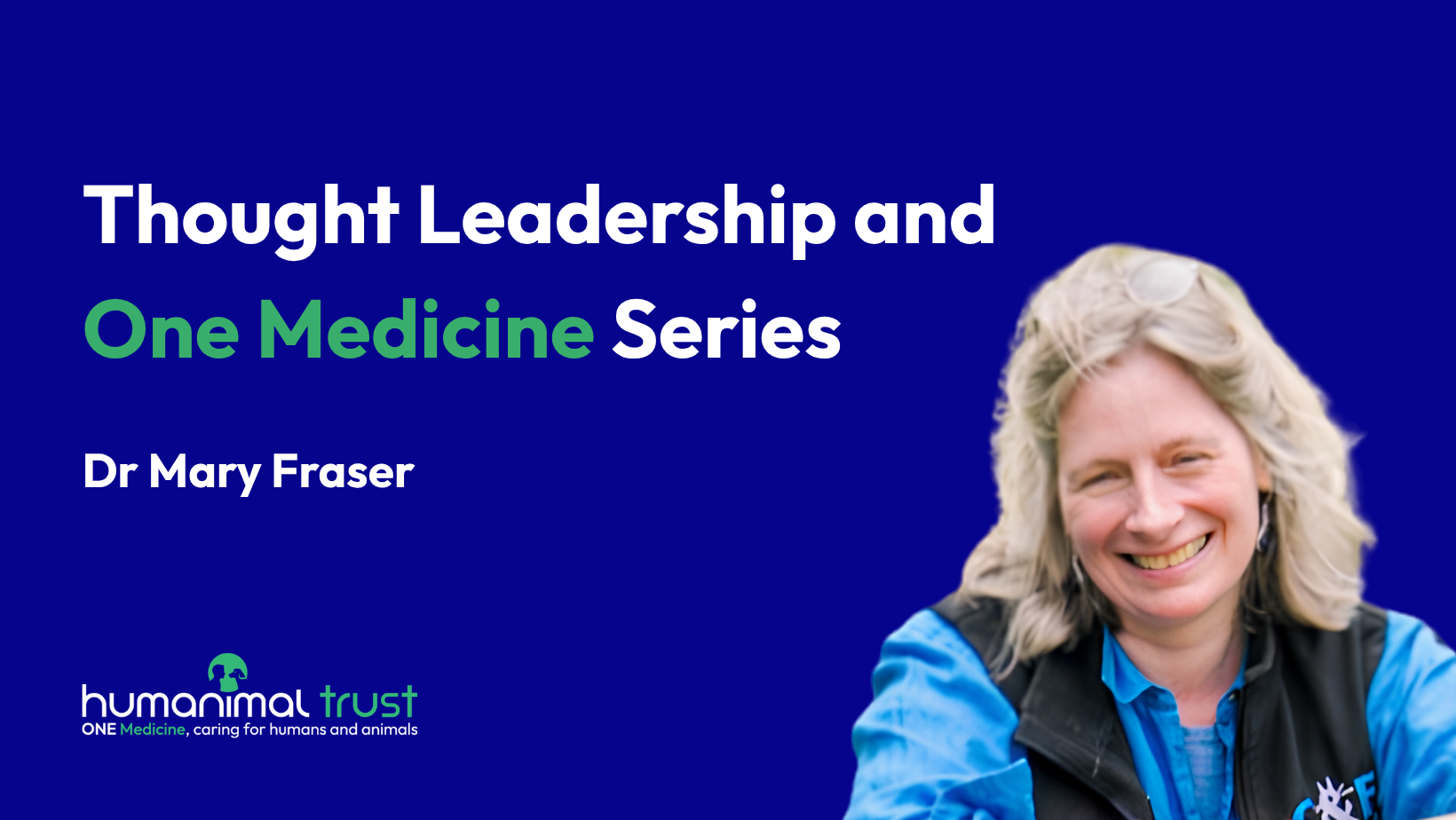
By Dr Mary Fraser
Humanimal Trust Chair of Trustees | Leader in One Medicine, Veterinary/Medical Education & Animal Welfare | Fellow RCVS | Podcast host | Veterinary Surgeon
Our thought leadership blogs are a series of articles designed to provoke thinking and discussion around the concept and application of a One Medicine approach. The opinions expressed in this article are the author’s own and do not represent those of Humanimal Trust or any other organisation mentioned.
How important are words? In recent years, particularly since the COVID-19 pandemic, the term One Health has gained prominence. Defined by the World Health Organisation (1) as an approach recognising the interconnectedness of people, animals and the environment, One Health has attracted significant attention, research momentum and, crucially, funding. However, the way this concept is currently interpreted and applied raises important questions about what – and who – is being prioritised.
Much of the research conducted under the One Health banner focuses on infectious disease in people, especially the prevention of future pandemics. Studies often centre on the interface between people and wildlife, the risk of zoonotic disease transmission from species such as bats and birds, and the growing threat of antimicrobial resistance. These are undeniably important areas of concern. Infectious disease does not respect species boundaries but disease transmission can take place from animals to people, or vice versa – as demonstrated when animals contracted COVID-19 from humans.
Shared environments, shared health
Human behaviour has a profound impact on animal health and the environment. Marine species, including whales, accumulate high levels of pollutants such as PCBs as a result of industrial activity. Around the world, antimicrobial resistance is detectable in waterways, while human sewage effluent releases hormones, antibiotics, parasites and pathogenic bacteria into rivers and ecosystems. These examples illustrate that human, animal and environmental health are inseparable.
Why One Medicine matters
Yet health is about far more than infectious disease alone. Chronic conditions such as arthritis, cardiovascular disease and cancer affect both people and animals. This is where the concept of One Medicine becomes essential. One Medicine recognises the full breadth and shared nature of disease across species and seeks parity between human and veterinary medicine in research, diagnostics and therapeutics – something that One Health, in practice, often overlooks.
The divide between human and veterinary medicine
I would suggest that the greatest barrier to achieving One Medicine is cultural rather than scientific. The term “medicine” is commonly assumed to refer exclusively to human medicine, while veterinary medicine is treated as a separate (and possibly less important?) discipline. Medical students study people; veterinary students study animals. The same distinction exists in nursing. These linguistic and educational separations reinforce professional silos, despite the extensive overlap in knowledge, skills and technologies. Words carry meaning, and these distinctions shape attitudes and behaviours.
Having worked in a variety of different organisations over the years, I’ve had the chance to spend time with veterinary and (human) medical professionals. Both are highly skilled and knowledgeable about their areas of expertise. But only a few medical colleagues have been interested in advances in the veterinary world. Often this is just down to a lack of time. ‘It would be lovely to find out more, but I’m just too busy at the moment,’ is a common response. But there is a more worrying response where I’ve been asked how veterinary medicine could be relevant to human medicine. So, I’m going to try to answer that question.
How veterinary medicine could be relevant to human medicine
Historically, much of what is known in human medicine has been derived from animal research. In the 19th century Darwin demonstrated that the facial expressions of apes and people could indicate emotions and pain, and that expressions shown by primates were similar to those of people.(2) In modern veterinary medicine grimace scales are now routinely used to assess pain levels in domestic animals (3). During my own doctoral research into canine atopic dermatitis, extensive parallels with human atopy became clear. Many of the medications used to treat the atopic dermatitis in people and animals are the same.
Animal models of disease have been fundamental to medical progress for centuries and laboratory animals are (alas) still studied in biomedical research. The degu (4) has been shown to have many similarities to humans affected by diabetes mellitus, lens opacities and Alzheimer’s. It does seem strange that it is acceptable to study animals in a laboratory and yet information from real life cases of spontaneous disease in pet animals, and the knowledge of the veterinary profession is often disregarded.
Having worked in both veterinary practice and medical education, alongside human and veterinary nurses and physicians, the similarities between the two disciplines are unmistakable. Diagnostic tools, treatment modalities and clinical challenges often mirror one another. There are many areas of overlap and so many opportunities to advance knowledge together.
Towards a more inclusive future for healthcare
Cultural change is slow and often generational, but it is possible. Animals are increasingly recognised as sentient beings (5) and regarded as integral members of families. Legal frameworks now reflect this shift, and technological advances in veterinary medicine often match an- d sometimes exceed – those in human health care. Imaging, anaesthesia, endoscopy, orthopaedics, dentistry and pharmacology are shared domains, as are treatments for conditions such as hypertension, hyperthyroidism, chronic pain and dermatological disease to name but a few.
The potential benefits of genuine collaboration between doctors and veterinarians are substantial. Combining the vast datasets available in both human and animal health could accelerate advances in diagnosis, treatment and prevention for all species. Humans and animals share common anatomy, physiology, pathology and pharmacology; continuing to place them in separate conceptual boxes limits progress.
Ultimately, the question is not scientific but ethical and societal. What kind of society do we wish to be? One that emphasises division between humans and animals, or one that recognises shared biology and shared vulnerability, striving to improve health and wellbeing for all? Embracing One Medicine offers an opportunity to move beyond silos and towards a more inclusive, effective and compassionate model of health care for people and animals.
References
- WHO (n.d.) One Health https://www.who.int/health-topics/one-health#tab=tab_1
- Kavanagh E, Kimock C, Whitehouse J, Micheletta J, Waller BM. Revisiting Darwin’s comparisons between human and non-human primate facial signals. Evol Hum Sci. 2022 Jun 23;4:e27. doi: 10.1017/ehs.2022.26. PMID: 35821665; PMCID: PMC7613043.
- Ardiles AO, Ewer J, Acosta ML, Kirkwood A, Martinez AD, Ebensperger LA, Bozinovic F, Lee TM, Palacios AG. Octodon degus (Molina 1782): a model in comparative biology and biomedicine. Cold Spring Harb Protoc. 2013 Apr 1;2013(4):312-8. doi: 10.1101/pdb.emo071357. PMID: 23547147; PMCID: PMC4386868.
- Legislation.gov.uk (2022) Animal Welfare (Sentience) Act 2022 https://www.legislation.gov.uk/ukpga/2022/22
You can find out more about Dr Mary Fraser here and hear more from her in our One Medicine Webinar series.
If you enjoyed this blog, please consider making a donation. As a charity, we rely on your support to enable us to continue our work, connecting human and animal medical professionals to advance the health of people and animals alike. Donate here.
READ MORE BLOGS FROM OUR ONE MEDICINE THOUGHT LEADERSHIP SERIES