
By Dr Yasmin Bedi
NHS Medical Consultant in Geriatric Medicine | Humanimal Trust PGIE Group Member
Our thought leadership blogs are a series of articles designed to provoke thinking and discussion around the concept and application of a One Medicine approach. The opinions expressed in this article are the author’s own and do not represent those of Humanimal Trust or any other organisation mentioned.
Geriatric Medicine is a medical speciality dedicated to the care of older adults. It is a relatively new specialty, only coming into being in the 1930s when Dr Marjorie Warren inherited a workhouse with many long stay older residents. As a pioneer, she chose to do something radical – she opted to rehabilitate as many of these individuals as possible so they could return to society (1). There were many other notable pioneers in this field, including Professor Bernard Isaacs, who in the 1960s, realised that older individuals needed a broader approach in their care to include wider socioeconomic factors and medical care, and coined the term ‘Geriatric Giants’, which consisted of Immobility (reduction in the ability to walk), Instability (increased falls risk), Incontinence (predominantly urinary) and the Impairment of Intellect (cognitive impairment/Dementia) (2).
Over the last few decades as research and understanding has developed, other key concepts in the care of older individuals have come to include harm from multiple medications and treatments and the Frailty Syndrome.
Understanding Frailty
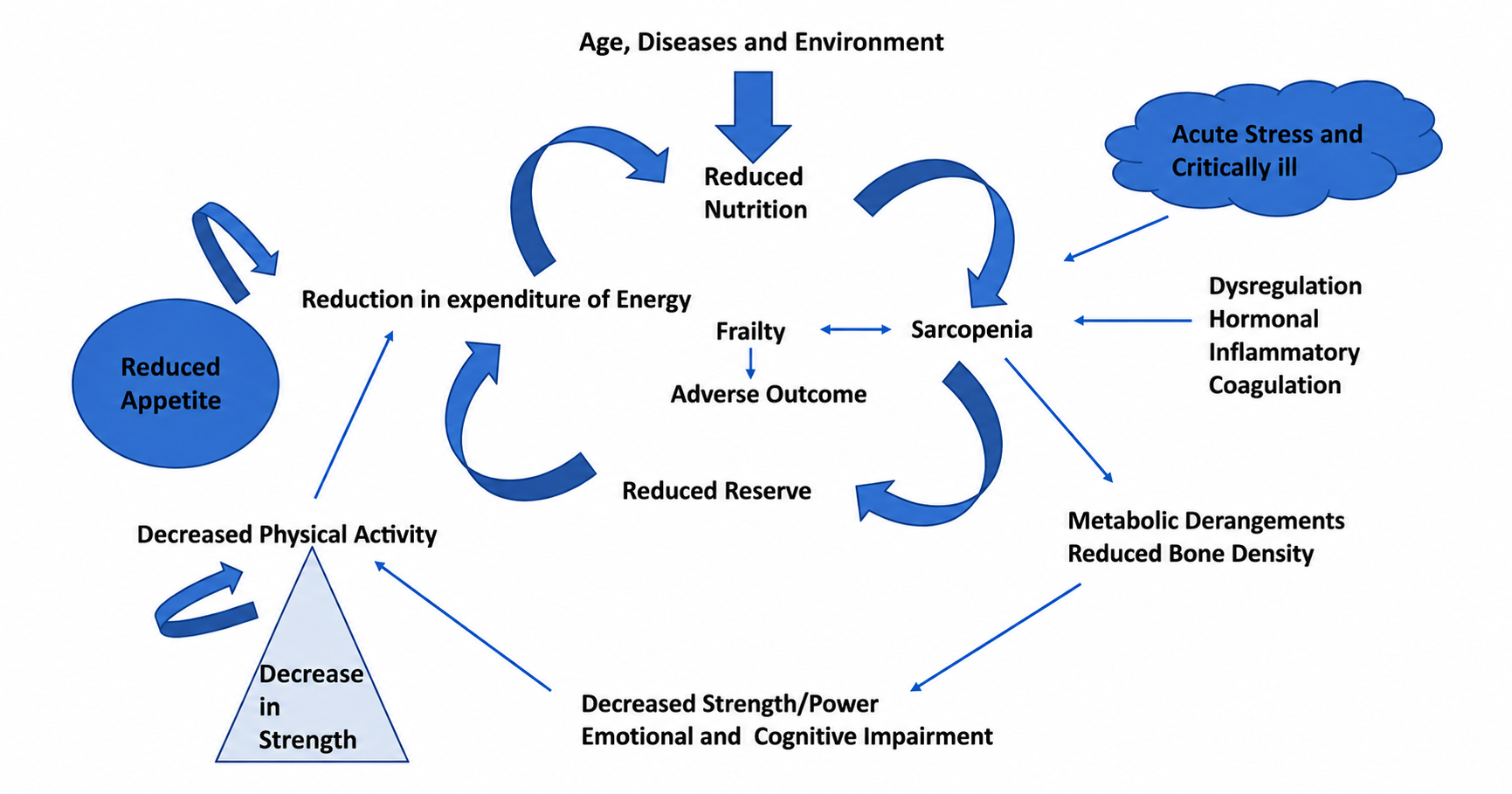
Frailty is a distinct syndrome that makes individuals vulnerable to developing ill-health in the context of events that may not be considered so serious in a younger, fitter person. This may include a fall or an infection that leads to a cascade effect with consequences including reduced mobility or cognitive impairment that may not be fully reversible. Frailty generally manifests physically as the loss of muscle mass, reduced appetite, impaired mobility, falls and the requirement for care, potentially leading to placement for nursing care. This is demonstrated through the Frailty Cycle (3).
Applying Geriatric Principles to Companion Animals
So, how does all this relate to animals? Well like many of you, I have had animals my whole life. And many have lived into old age. For a decade I adopted Senior Staffordshire Bull Terriers from the Dogs Trust, and it is through sharing the story of Thelma that I am going to explain the Comprehensive Geriatric Assessment. This is the gold standard approach to the care of older adults in the NHS and is defined as ‘a multidimensional, multidisciplinary process that identifies a person’s medical, social and functional needs and the development of an integrated and coordinated care plan to address these needs’ (4). I hope this will persuade you that this holistic model of care applies to older companion animals too.
Thelma’s Story: Growing Older with the Right Support
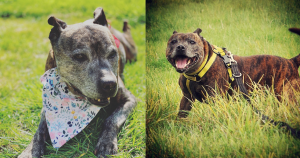
Thelma was 10 years old when I adopted her but had been at the Dogs Trust for 6 years. She had been one of their longest stayers, and over the years had had 2 failed adoptions due to a combination of being dog-reactive and sheer bad luck.
By the time I adopted her, she had started to develop bony arthritis, also called osteoarthritis, which is also very common in older adults. Thelma was on pain medications and a joint support supplement. She also had occasional urinary incontinence and was on medication drops once daily to manage this.
As she had a long term medical condition, she was classed as a Share Adoption Scheme dog which meant that the Dogs Trust financially covered most of her medical treatment. All treatments had to be approved by the Shared Adoption Scheme team and I saw this as a second opinion and sense check for supporting Thelma as she aged.
Thelma was a typical Staffordshire Bull Terrier, full of love, great with kids but with terrible separation anxiety. Luckily, she was in a home that always had someone home, and with time as her trust in us grew, her dog-reactivity started to settle. Thelma remained in relatively good health, enjoying at least one good winter running through the extremely muddy water meadow and rolling in the spring flowers as summer approached.
Managing Osteoarthritis Through Teamwork
At the age of 11, as the weather turned cooler and damper, I started to notice that Thelma was slowing down. Her legs were skinnier and she was beginning to lose muscle mass. Where she would often break into a spontaneous run when we went out in the field, she had started to do a little sideways trot, suggesting pain. This eventually culminated in a fall down the stairs when she was trying to run up the stairs behind me, thankfully resulting in no injuries but some loss of confidence.
My vet felt that Thelma’s osteoarthritis was worsening in her upper limbs, which is common amongst bully breeds due to their muscular build. She had a short course of high strength anti-inflammatories to reduce the pain and had x-rays which confirmed she had severe arthritis in both shoulders and elbows with the right side being worse, explaining her sideways walk as a way to reduce the weight going through that side.
As she was a Shared Adoption Scheme dog, Thelma was covered for hydrotherapy where she could be assessed, and a course of treatment was commenced to support muscle strengthening to support the joints. On her first visit, she was weighed, measured, and introduced to the underwater treadmill. She also discovered squeezy cheese!
Parallel to this, the vet was seeing her regularly to review her response to hydrotherapy and discuss longer term options to manage her pain and support her mobility. The first option discussed was surgery, but it was clear that this was not for Thelma due to multi joint involvement and the severity. Other less invasive options were discussed but we chose to stick with hydrotherapy and stronger anti-inflammatory medications. Within three months, she was back to her old self, chasing squirrels and enjoying long walks.
This combination kept her happy and pain free. So that when a breast lump arose, I did not hesitate in having it removed under an anaesthetic because her quality of life and overall health was good. Thankfully, it turned out to be a localised cancer and she required no further treatment.
She remained well for a further 18 months, before she developed a sudden onset infection, and over 24 hours she rapidly deteriorated. Despite receiving oral antibiotics from her own vet, when she did rapidly deteriorate, it was the night of a bank holiday and so I had to take her to the emergency vet, a vet who had never met her before. With no attention to her medical records, I was told that she needed to be admitted to the Intensive Care Unit with quite some pressure exerted on me. I could see that Thelma was suffering and at 13 years she was very much a ‘senior’. All I had ever wanted for Thelma was a pain free, relatively independent life. So the suggestion that she should have lines put into her and have also sorts of tests in an unfamiliar environment, away from her family, felt wrong. Particularly, as I could see clinically that she was not going to survive.
In the end, it was clear that Thelma was ready to leave this world, as she pressed her head into my hand and didn’t even flinch when the needle was inserted into her wrist. My biggest regret was that she didn’t die at home surrounded by her family, but I am so glad that I did not allow her suffering to be prolonged.
Why Companion Animals Deserve a Comprehensive Geriatric Assessment
Despite the emergency vet visit at the end of Thelma’s life, which parallels what frequently happens in geriatric medicine, Thelma had a great team around her. The care of Thelma was never down to a single individual. She needed a home to adapt to her needs with constant companionship and the ability to walk her in a way that catered to mild dog-reactivity. As her mobility declined, her urinary incontinence worsened, again, mirroring what we see in older adults, and so we had to find ways to manage this so she was comfortable and we didn’t have urine everywhere. We also had to support her with the stairs after her fall.
Thelma needed ongoing vet care to manage her progressive osteoarthritis, and this was achieved by ensuring that she had a good veterinary practice and continuity of care, so that they knew her history and her baseline. It meant we had fully informed discussions around treatment options and we had the time to decide what would be best for Thelma. For Thelma, I think it was the hydrotherapy that made the greatest difference. The team were caring, dedicated, knowledgeable, and her rehabilitation was key in ensuring that she regained independence. Finally, the Shared Adoption Scheme team were there every step of the way to bring it all together. This collaboration with professionals, all working together to bring together expertise in their specialty field, is the very definition of what the Comprehensive Geriatric Assessment is, and as for humans it offers gold standard care for our companion animals too.
If you enjoyed this blog, please consider making a donation. As a charity, we rely on your support to enable us to continue our work, connecting human and animal medical professionals to advance the health of people and animals alike. Donate here.
READ MORE BLOGS FROM OUR ONE MEDICINE THOUGHT LEADERSHIP SERIES
Author bio:
Dr Yasmin Bedi is an NHS Medical Consultant specialising in Geriatric Medicine. She is a member of the Humanimal Trust PGIE (Patient and Guardian Involvement and Engagement) group in the role of human medical professional. She has fairly recently become a Chihuahua guardian, having adopted an opinionated Chihuahua called Otis.
References:
- https://www.bgs.org.uk/resources/history-of-geriatric-medicine-in-the-uk-pioneers-of-geriatric-medicine
- https://www.bgs.org.uk/a-giant-of-geriatric-medicine-professor-bernard-isaacs-1924-1995-post-1
- https://cdn.ymaws.com/www.iayt.org/resource/resmgr/docs_pubs_ytt/sample_article_summer.pdf
- https://www.bgs.org.uk/resources/silver-book-ii-holistic-assessment-of-older-people