
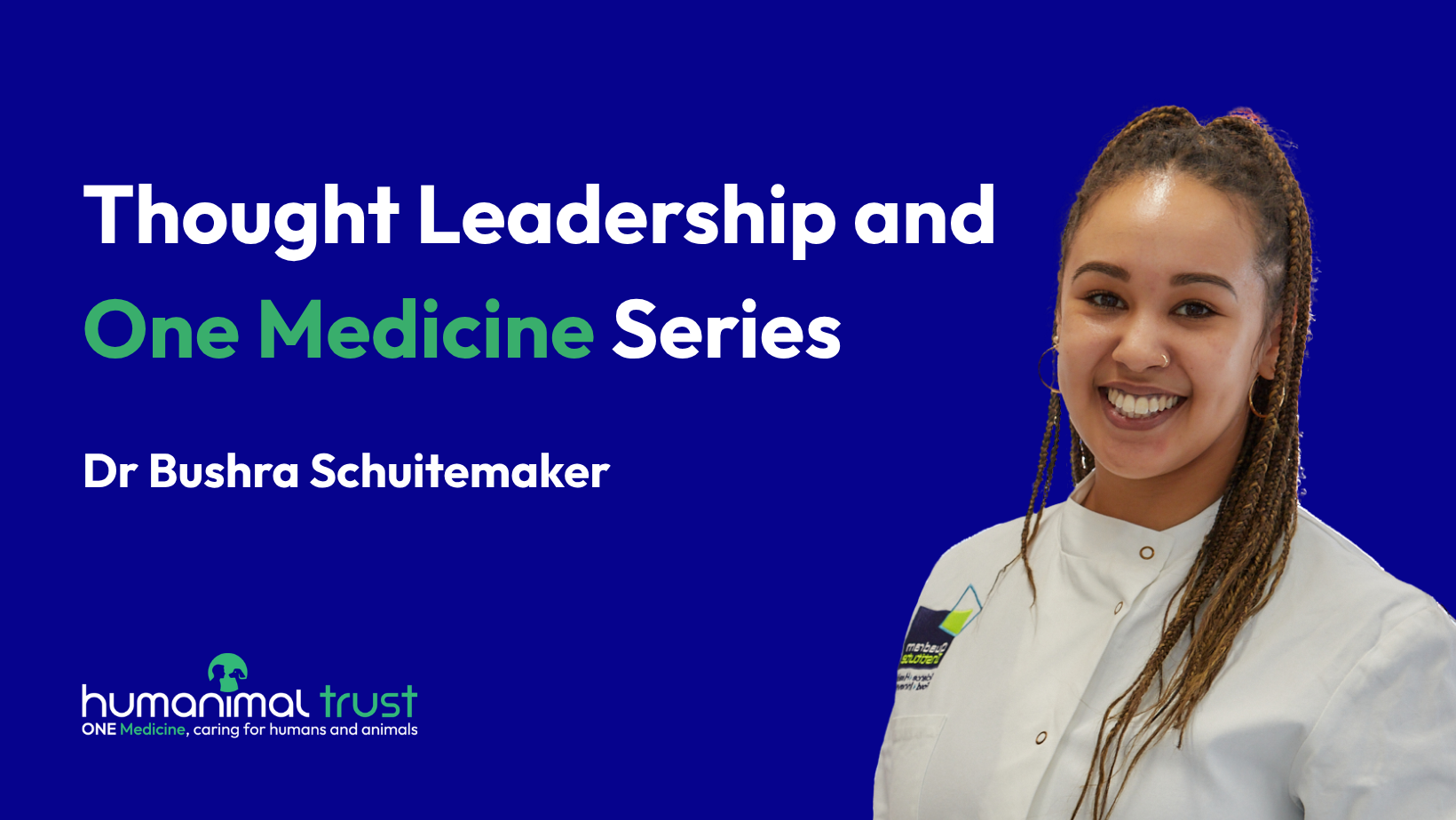
By Dr Bushra Schuitemaker
Head of Science and Research at BIOME9 | Head of Microbiology at Pooch & Mutt | Humanimal Trust Science Committee Member
Our thought leadership blogs are a series of articles designed to provoke thinking and discussion around the concept and application of a One Medicine approach. The opinions expressed in this article are the author’s own and do not represent those of Humanimal Trust or any other organisation mentioned.
From zoology to microbiomes: a personal route into One Medicine
I trained as a zoologist. My undergraduate degree was in zoology, driven by a deep curiosity about animals, evolution, and how life adapts to different environments. That curiosity never went away, but it did take an unexpected turn. I subsequently completed a PhD in poultry science, focusing on biomarkers of health and welfare in faecal samples. In simple terms, I spent several years studying what animals leave behind, rather than what goes in.
Since then, my career has continued to centre on the idea that we can learn an extraordinary amount about health, disease, and resilience by studying the gut microbiome. I have worked in comparative oncology, paediatric microbiome and metabolism research, and obesity in children. Across all of these projects, the same patterns kept appearing. Whether the patient was a chicken, a dog, or a child, the microbiome behaved in familiar ways.
Today, I am Head of Science and Research at BIOME9, where my work focuses on applying microbiome science within veterinary and animal health settings. Much of my working life revolves around faeces, because faeces contain one of the richest biological datasets we can access non-invasively.
This perspective naturally aligns with One Medicine. When you spend your time comparing animals, microbes, and disease across species, the boundaries between human and veterinary medicine start to look surprisingly thin.
The power of poo
Faeces are not just waste. They are foundational to ecosystems, agriculture, and health. Animal poo fertilises crops and underpins food chains. Elephant dung is so fibrous that it can be used to make paper. Bat guano, rich in nitrates, was historically used to make explosives. Wombats produce cubic poo, a phenomenon that has fascinated and confused biologists and physicists alike.
This diversity in defecation reflects a broader truth: the animal kingdom is extraordinarily diverse, and so are its microbiomes. When you look at tree of life classifications the parallels between host evolution and microbial evolution become clear. Different animals host different microbial communities, but the underlying principles are shared.
What is the microbiome?
The microbiome refers to the communities of microorganisms that inhabit a particular environment, such as the gut, skin, or respiratory tract. These communities are not random collections of microbes. They are complex ecosystems that interact with their host and with each other.
Microorganisms existed long before animals. Early bacteria were producing oxygen more than two billion years ago, shaping the planet long before complex life emerged. As animals evolved, they did so together, alongside microbes.
When we talk about the microbiome, we often focus on bacteria, but they are only part of the picture. Fungi, archaea, protists, and viruses all play important roles. In many microbiomes, viruses outnumber bacteria, and bacteriophages shape microbial populations, functions, and stability.
The microbiome as a shared organ across species
Across all species studied to date, the microbiome behaves like a functional organ. It develops during critical early life windows, adapts to environmental pressures, and can fail in predictable ways. When it fails, disease often follows.
This is what makes microbiome science uniquely powerful for One Medicine.
Microbes have co-evolved with animals, co-developed with immune systems, co-metabolised food, and co-regulated key physiological processes. They influence immune, nervous, and endocrine development, shaping metabolism, inflammation, and resilience. These relationships are not species-specific curiosities. They are conserved features of animal biology.
When biology is conserved, medicine can be shared.
Understanding microbiome diversity
To understand microbiome health, it helps to think like an ecologist. Imagine a forest. A forest with only one type of tree is vulnerable. A forest with many species in balanced proportions is more resilient. The same principles apply to the microbiome.
In microbiome science, diversity is not simply about having more microbes. It is about richness, balance, and stability. We aim to maintain sufficient diversity of microbes to perform essential functions, without any single group dominating and crowding out the rest. These ideas originate directly from large scale ecology and are applied almost unchanged to microbial ecology.
In medicine, diversity is not about more being better. It is about the appropriate function for that individual at that time. These principles apply whether the patient walks on two legs, four legs, or has wings.
Gut axes: how microbes talk to the body
The gut microbiome influences multiple body systems through interconnected pathways known as gut axes. Communication is bidirectional, meaning the gut influences other organs, and those organs influence the gut.
There is a gut-brain axis involving neurotransmitter precursors and vagal signalling. Gut-skin, gut-lung, and gut-liver axes reflect shared immune and metabolic pathways. The microbiome also influences immune regulation, glucose and lipid metabolism, and links to muscles, bones, kidneys, cardiovascular and reproductive systems.
These axes are not unique to humans. They exist across animal species, reinforcing the idea that microbiome-mediated health is a shared biological framework.
Where microbiomes come from
Microbiomes are established early in life. Birth, delivery method, and lactation all shape the initial microbial community. In early life, host-associated factors dominate, and disruptions during this window can have long-term consequences. In humans, caesarean delivery, bottle feeding, and early antibiotic use are associated with increased risks of allergies, eczema, and gastrointestinal disorders. This is conserved across mammals.
Different mammals illustrate this beautifully. Although the mechanics of birth vary enormously across species, the underlying principle is strikingly conserved: early microbial transfer is essential for healthy immune development.
Dingoes, like humans, have a placenta and are born after gestation, acquiring microbes during birth and through milk. Red kangaroos give birth to extremely underdeveloped young that continue development in the pouch, where the pouch microbiome dynamically changes during lactation to shape the joey’s microbial exposure. Monotremes, such as the platypus, lay eggs and have a cloaca, with microbes transferred during egg laying, hatching, and from the nest environment.
Despite very different reproductive strategies, the outcome is the same: early microbial seeding during a critical window supports immune development and long-term health.
Companion animals as One Medicine partners
Dogs develop many of the same chronic diseases seen in human medicine, including inflammatory bowel disease, dermatitis, and epilepsy. These are not merely analogous conditions. They share inflammatory pathways, microbial signatures, and treatment challenges.
Companion animals play a unique role in translational research. They live in the same environments as humans, eat processed diets, experience stress, and receive medical care. Compliance with treatment and follow-up is often high due to the human-animal bond. Naturally occurring animal diseases allow us to study disease progression and treatment in ways that are often impossible in human trials.
Comparative studies have shown substantial overlap in gut microbiome between humans and dogs. Shared functions include carbohydrate metabolism, bile acid metabolism, and fatty acid production. Despite this overlap, strains remain host specific, highlighting functional conservation rather than direct microbial sharing.
Strikingly, dogs show greater similarity in their gut microbiomes to humans than to mice or pigs, despite pigs being genetically closer and mice being the most common laboratory model. This similarity is likely driven by shared changes in how bodies work over generations and lifestyle rather than cohabitation alone.
Applying microbiome science in practice
Modern gut microbiome analysis typically starts with a faecal sample. DNA is extracted and sequenced using next-generation sequencing technologies. This allows us to identify which microbes are present, their relative abundance, and their functional potential. We combine this with information about host and environmental factors such as age, breed, and diet.
In my current work, we consistently observe improvements in key microbial markers in dogs within months of targeted dietary and supplement-based interventions. This demonstrates that the microbiome is not only measurable but modifiable.
Research into domestication further highlights shared biology. Domestic dogs and humans both carry multiple copies of a starch digesting gene, reflecting adaptation to starch-rich diets. Wolves and dingoes carry far fewer copies. Understanding how the microbiome shifted alongside these genetic changes helps explain modern inflammatory and metabolic disease in both species.
One Medicine in action: microbiome-based approaches today
Microbiome-based approaches are already used across species. Probiotics are prescribed for inflammatory bowel disease. Faecal microbiota transplantation is used in humans and animals. Nutrition is increasingly personalised to support metabolic health. Alternatives to antibiotics, including phage therapy, are being explored to address antimicrobial resistance.
Antimicrobial resistance does not respect species boundaries. The microbiome is one of the few systems where we can intervene before resistance emerges, making it central to One Medicine.
Lessons from birds, insects, and beyond
Poultry microbiome research has applied One Medicine principles for decades. Competitive exclusion and probiotics are used to establish healthy gut communities early in life, reducing pathogen colonisation and disease. This is preventative medicine, not just agriculture.
Wild birds offer additional insights. The hoopoe, for example, uses bacteria in its preen gland to produce antimicrobial secretions that protect feathers and nestlings. Migratory birds show how microbiomes adapt under extreme stress, and how disruptions can increase disease risk and spread antimicrobial resistance across populations.
Even hibernating mammals teach us about microbiome-mediated adaptation. During hibernation, gut microbes help recycle nitrogen, preserve muscle, and support metabolic suppression. These insights may inform treatments for malnutrition, ageing, and even long-duration space travel.
Shared biology enables shared medicine
Across species, the microbiome behaves in remarkably consistent ways. Naturally occurring animal disease accelerates understanding and bridges laboratory and real-world medicine. One Medicine is not aspirational; it is already shaping prevention and treatment across human and veterinary healthcare. By recognising the microbiome as shared biology, we move closer to truly collaborative medicine.
Human and animal health professionals and researchers can also read a more in depth version of the blog in our One Medicine Network: HERE (request to join if you haven’t already).
Author bio
Dr Bushra Schuitemaker is a zoologist and microbiome scientist working across human and animal health. She is Head of Science and Research at BIOME9 and Head of Microbiology at Pooch & Mutt, with research interests spanning One Medicine, microbiome-driven health, and translational veterinary science. Bushra is also a member of the Humanimal Trust Science Committee.
You can hear more from Dr Bushra Schuitemaker in our One Medicine Webinar series.
BIOME9 is part of the One Medicine Network Business Directory – a growing community of forward-thinking companies united by a shared belief: that human and animal health are deeply interconnected. The directory brings together organisations that actively practice, promote, and support a collaborative approach to medicine across species. Email info@humanimaltrust.org.uk if you would like to request that your company be added to the directory.
If you enjoyed this blog, please consider making a donation. As a charity, we rely on your support to enable us to continue our work, connecting human and animal medical professionals to advance the health of people and animals alike. Donate here.
READ MORE BLOGS FROM OUR ONE MEDICINE THOUGHT LEADERSHIP SERIES